Wednesday, December 7, 2011

Huayna Potosi: The Hardest Thing I´ve Ever Done (10/18-10/19)

I try not to overuse superlatives, as there´s always the possibility of going off the deep end into hyperbole, but sometimes they really are the absolute best expression of an activity. I am well aware I already characterized climbing Cotopaxi as ¨the hardest thing I´ve ever done,¨ and I don´t want readers to think that I throw that phrase around lightly, but - quite honestly - I found something that surpassed Cotopaxi in difficulty. Its name - quite innocent, actually - is Huayna Potosi (¨Young Mountain¨ in Quechua).
Huayna Potosi in full glory
Standing at 6,088 meters above sea level, this snow-capped peak can be climbed in two days, though three is recommended. Savoring the end of a 5 bolivano ($0.90) meal and leisurely drinking a beer at around 7pm one evening in La Paz, Scott and I considered the options. He really wanted to ¨bag¨* a 6,000-plus meter peak (*Lonely Planet Language), and I wasn´t about to be left behind in La Paz, although the idea absolutely terrified me. Maybe it was the half-beer, maybe it was the incredibly drunk Bolivian man who kept coming over to our table and yelling, ¨My name is...?¨ but I decided I´d go for it. Less than an hour later, we´d paid our Bs. 700, heard the spiel about what to bring (including chocolates, altitude pills, coca leaves), and committed to attempting this ridiculous feat.
The next morning, we arrived on time to the office, although it took quite some time for all of the equipment to be assembled. Only one other climber - an affable 36-year-old Danish man named Karsten - had opted for the two-day trek; most of the group was already at Base Camp. Two hours and one incredibly bumpy van ride later, we were eating lunch at Base Camp, listening to the warning of the group that had just returned.
Scott on a scree slope below the snow line

¨This is the hardest thing you will ever do.¨
¨I only made it to 6,000 meters...the last 88 really kill.¨
And, audibly, as they were climbing into the van, ¨Hah. They have no idea what they´re in for.¨

We packed our bags: ice pick, crampons, helmet, boots, snow-protection for our ankles, pants, jackets, and neck gators - combined with our sleeping bags and extra warm layers, it was about 35 pounds of equipment. So laden, we began our climb to High Camp. About two hours later, exhausted by the packs and the beauty of the surrounding peaks, we stumbled into High Camp, where bright sunshine, loud French people, and comfortable bunk beds greeted us. We spent the afternoon pretending to be bravely contemplating that night´s venture, including reading - and scoffing at - the myriad graffitis inside the refugio´s walls, mostly suggesting we turn back immediately.
The route to the top
We ate dinner of soup and pasta at 5pm, and a helpful Australian doctor suggested I could safely take up to twice my prescribed dose of altitude pills, should I begin to feel ill. Although, he warned, I might get tingly fingers. In my head I thought about punching him in the nose; I´d take tingly fingers over headaches, vomiting, diarrhea, upset stomach, loss of concentration, and temporary dementia any day of the week.
Around 6pm, we were urged to bed, and everyone spent the next 6 hours trying not to think. I took the opportunity to visualize myself reaching the top, ice pick waving valiantly in hand.
The only time I got up was to use the restroom, and when I went outside, the moon had not yet risen. The stars were clustered thick and bright over the blanketed snow, and the clouds - below me - glimmered in their faint light. I breathed deep and thought, ¨I can do this.¨
We got up to pitch darkness around midnight, put on our gear, and slung our light packs (water, chocolates, sunglasses, camera, my avalanche-whistle) over our shoulders. Then, headlamps turned on, crampons attached, and ice picks in hand, we began the long, slow climb into Moria. I mean Huayna Potosi. Now, if you are unfamiliar with crampons, as I was, you should know that they are basically heavy, inch-long spikes of metal that are attached to the bottom of ski boots; not exactly idea climbing footwear. In addition, my boots were a bit too big, since the next smallest pair was made for babies (incidentally, one of the graffitis at High Camp said, in sprawling, uneven handwriting: ¨Llegue con 9 años¨ - a 9-year-old summited).
Sunset at 5,300 meters
The first hour felt surprisingly good; I got into a rhythm with my ice pick on the steeper parts, where it was necessary to walk sideways. Plant ice pick and cross right foot over left, step left foot, extend knee and rest. One, two, three. One, two, three.
I purposely didn´t check my watch, nor did I ask our guide, Silverio, how high we were, since I had decided fewer indications of our (lack of) progress were better. At around 3:15am (we´d started at 1:45), we paused, and were informed we´d reached 5,500 meters. Scott was elated; I was crushed. We weren´t anywhere near halfway. I´d like to credit the altitude, but I got snappy. The words ¨no puedo¨ (because I was inexplicably speaking to myself in Spanish throughout most of the hike) crept into my mind. I forced myself to think about ten positive thoughts to counteract that single negative one that had crept, unbidden, into my mind. But the seed of doubt had been planted.
 Before continuing on, we switched off our headlamps; the moon was plenty bright to guide us. Up ahead, inconceivably high on the dark wall of snow ahead, we could see the lights of little triplets of climbers, tied together by safety ropes...they looked like the lights of the Polar Express, winding up, zig-zagging back and forth in the impossibly steep cold.
All geared up and rarin´ to climb!
We switched our  lights back on when suddenly a hulking darkness blotted out the moon. It was the steepest part in the trail, where we´d be ice climbing. The switchbacks grew narrower and steeper as we ascended the face, and soon Silverio turned to us and, without speaking, indicated how we were to dig our picks into the ice face directly above us, readjust our footholds a few inches higher, then loosen the pick and re-attack the face. A few harrowing minutes later, we were perched upon the top of the wall, shaking with cold and the nearness of disaster. By this point, it had gotten hard for me to breathe, and I could barely swallow the water Scott offered me. It was impossible to stop for long, as I was also freezing in the snow, and Silverio pulled my hood up over my  helmet and zipped me deeper into my jacket. Unfortunately, it was almost impossible to continue without resting, so I slipped into a personal hell of cold fatigue. While we were moving, I did fine, wondering if llamas had to acclimatize at altitude, and mentally humming (for whatever reason) ¨Home on the Range¨ and the UCSB fight song, but changing the words to ¨Olay, olay olay olay, cum-bre, cum-bre¨ (cumbre means peak in Spanish). But when we stopped, however briefly, I had to fight down the panic that was rising within me, as I imagined the blood freezing in its arteries on the way to my brain. At one point, breathing hard, Silverio instructed Scott to feed me altitude pills to fend off the terrified feeling.
I swear, it´s steeper than it looks
Just before the sun rose was the hardest part. We´d been hiking for over three hours, my body was exhausted, my mind was reeling, I demanded rest at every flat spot, and putting one foot in front of the other required all the strength I felt was left in my body. It was then that Silverio paused, turned to me, and said simply, ¨el sol viene.¨ Behind me, just beyond his outstretched finger, beyond the clouds that blanketed the world below, beyond the edge of oblivion, I could see the faint glow of the sunrise.
The next half hour was made slightly less difficult by the knowledge that soon the world would be thawed, softened, and warmed by that life-source. And yet the doubt kept growing. It was before the sun was fully in the sky, sprawled painfully in the snow during a brief rest, that I finally gave voice to my doubts. I knew Scott would summit, and the travel agent had explained to us that if one person wanted to descend, they would do so with a guide, but that the other person could continue with another group. This was seeming more and more like an option. I felt so panicked by not being able to breathe that I was almost crying when I turned to Scott and told him, ¨I´m not sure if I can do this.¨ He was understanding, relaxed, unworried. Which actually endowed me with more motivation; maybe no one expected me to summit, which would make it all the more satisfying if I did.
But at the next break, I was in even worse shape. We´d reached a natural bridge over a crevasse, the sun was full in the early-morning sky, and another steep face rose above us, just to the right of a sheer rock face. I was lying in the snow, trying to summon whatever power was left in me, when Silverio pointed again. ¨Ves las rocas aca? Esta es la cumbre.¨ The summit was in sight. It was an hour and half of steep snow ridges from where we were sitting to the very highest point on the mountain. The despair in my chest turned to relief. I was half-crying, half-laughing, and because my cold lips and reeling mind had lost the ability to form words many hours before, Scott looked alarmed. But I stood up with renewed vigor, and - for the first time - I realized I might make it to the top. We were at 5,900 meters.
Sunrise, somewhere over the altitude where breathing´s possible
And so we pushed on. At the top of the next steep face, we ran into Karsten (we´d named him Captain Denmark for his nonchalant, but modest mentioning of the four Iron Man competitions he´d completed, along with Adventure Racing - a sport invented for those who think Iron Man leaves something to be desired, intensity-wise). He´d left before us, and made it to the summit before sunrise. He smiled and hailed us from afar, shouting questions and exclamations and taxing my ability to choke words out. He also said I looked better than Scott, a comment that Scott took very personally, and although I knew it to be far from the truth, I appreciated nonetheless.
But as he descended, and we´d had a moment to pause, the panic and inability to breathe came back with renewed force. I bent double over my ice pick, breathing shallowly and fighting tears. Again, I hope I can attribute this apparent loss of sanity to the altitude, but I felt truly terrible. Silverio turned to a descending guide and asked him to wait. Then he turned to me, and put his hand understandingly on my shoulder.

Summit: Lake Titicaca in the background
¨Si sientas bien, puedes subir. Pero si sientas mal, es mejor bajar, porque vas necesitar energia para bajar. Pero la decision es tuya.¨
- If you feel ok, you can summit. But if you don´t you should turn around, because you´re going to need energy for the hike down. The decision is yours.
I knew the answer, but it took me a few seconds to muster my voice. I breathed deeply a few times, calming the panic, looked him in the eyes, and gasped, somewhat savagely, I assume:
¨Voy a subir.¨
- I´m going to summit.

Silverio smiled, Scott probably grimaced, and I took another step forward. The final ascent was hard, maybe the hardest of the whole trek; it featured icy pinnacles, full jumps across 50-foot crevasses, and narrow shuffling over windy ridges.
Descent
The path upwards looked impossible, and there was one pause where we sat with a full thousand-meter vertical drop at our backs. But I could see the peak, and I was no longer worried; it might take three hours, but I was going to the top. I counted the steps in my head, and first I took 30 stops before pulling on the rope to indicate to Silverio, at the lead, that I needed to rest. The next time I took 40. The next time, I didn´t need to count, because we´d reached the summit.

There are no words in the English language to express what it felt like to reach the top. I don´t even think it´s worth it to try. I no longer felt like crying, but the simple, pure exhaustion that flooded my body was augmented by a small, cool pride, which grew as Scott and I rested at 6,088 meters, and Silverio took photos of us. It was 7:20am, 5h35 minutes after we´d begun.
Scott´s graffiti
We were at the top maybe ten or 15 minutes, and then we started back down. As it turned out, Silverio was right; you couldn´t just roll back down the mountain. Though the steps moving down were incomparably easier than those ascending, they still required a concerted effort.
Just after we descended from the rocky peak, too, a heavy cloud rolled in, bringing snow and silence with it. We´d hoped to see the startling vistas we´d missed at night, but the snowy clouds were too thick. They also made it impossible to measure progress, so I found myself lost in an impenetrable fog of timeless fatigue.
My graffiti (please excuse the effects of altitude)


We reached the refugio at around 9:30am, where we were fed soup (I had no appetite; the altitude also affects the digestive system) and allowed about 45 minutes to rest. Scott and I climbed into our bunks, laughing that we were expected to sleep while surrounded by a group of guffawing French 60-year-olds who hadn´t made it to the top, but who had apparently been guzzling booze all morning, then promptly fell asleep.
Silverio woke us what felt like minutes later. We packed our heavy bags, put our normal hiking shoes on, wrote our own graffitis, and spent an hour and half more descending to Base Camp. We deposited our equipment, climbed into a van, and rode back to La Paz, almost sleeping on the way, despite the violently potholed road.
Back in our hostel around 2:30pm, we fell into our beds. I awoke almost 18 hours later, exhausted and proud. I still can´t believe I did it.

Monday, December 5, 2011

Bolivian Lake Titicaca: Copacabana & Isla del Sol (10/13-10/18)

A quick disclaimer: the two towns mentioned in the title - Copacabana (like the Brazilian resort town) and Isla del Sol (literally ¨Island of Sun¨) would imply that we´d begun the tropical part of our trip. Sadly, this is not the case. At something like 3,800 meters, Lake Titicaca is frigid even on the sunniest of days.

Border Crossing: Characteristic poor planning
Looks innocuous enough....
As a citizen of the United States, it is obligatory to pay $135 for a Bolivian visa upon entry to the country. This relatively astronomical sum (a month in Peru costs about $600) had tortured both Scott and me for several weeks; we weighed the value of visiting the Amazon jungle and the mysterious Salar de Uyuni against our wallets, and in the end we´d decided (somewhat grudgingly) to make the intial investment in a country touted above all for its cheapness.
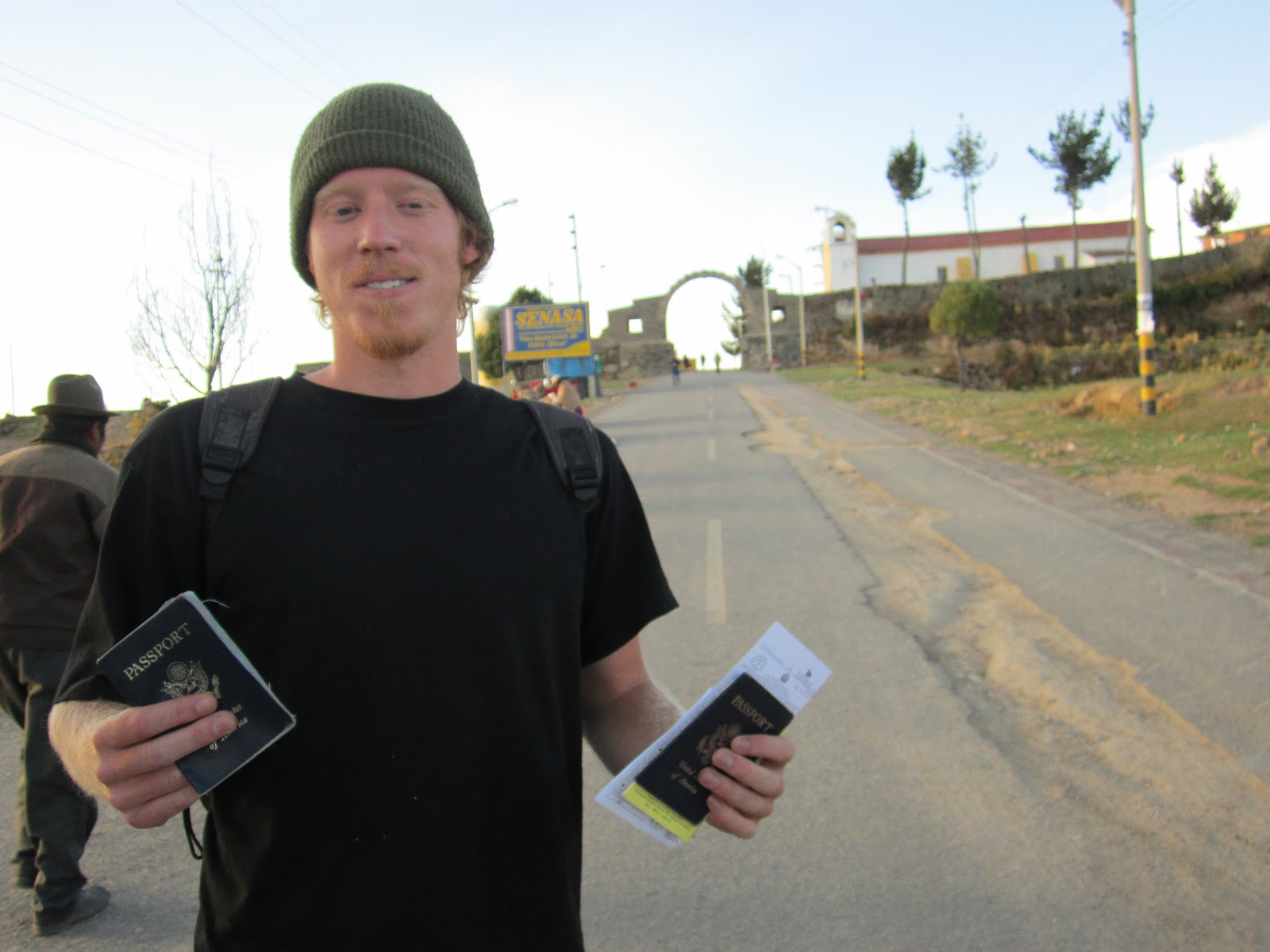
All ready for his border crossing! ...kind of.
Obtaining U.S. dollars to pay this sum, however, turned out to be a bit easier said than done. Our unwillingness to withdraw money from any bank but Scotiabank (Bank of America´s sister, no ATM charge), and Scotiabank´s policy not to dispense more than 100 USD per customer per day led us to embark on the border bus with only barely enough money to pay the crossing. I had $40 in reserve in addition to my $100 withdrawal, and Scott had his $100 plus about $30 worth of Peruvian soles...we were cutting it rather close. In addition, we lacked the 4x4 color photograph the U.S. State Department said we´d need, and Scott had lost both his immunization records and the copies of his immunization records somewhere back in Puerto Rico. Needless to say, we were a bit nervous upon arrival to the border crossing.
Fortunately, Scott was able to change his Soles for dollars (and my remaining Soles for dollars) on the Peruvian side of the border, and we happened to be carrying copies of our passports that the officials accepted as photos. As is becoming customary, the officials gave Scott trouble for having a water-stained passport, but eventually we got our visas, our entry stamps, and back on our bus. We had $5 USD and 3 Soles between us as we entered Bolivia.

Copacabana
Non-photoshopped image of the sunset from Copacabana
Arriving in Copacabana, in true fashion, we were informed that the city didn´t have any ATMs. Thankfully, this turned out to be faulty information, and - pockets full of bolivianos - we checked into our (unbelievably fancy) ho(s)tel (the State Dept also told us we´d need proof of hotel reservations in Bolivia in order to cross - they didn´t), then, along with a new friend, we headed to dinner. As we sat down, laughing, I joked that I was due to get sick soon, since several travelers had informed us Bolivian food was not exactly sanitary much of the time.


Isla del Sol: Sick Boy returns
This joke proved prophetic: on the boat to Isla del Sol the next morning, after boasting loudly that I never get seasick, I began to feel incredibly sick indeed. By the time we docked on the island, I was close to full stomach upheaval, and it was all I could do to stumble to a nearby patch of grass and fall to my knees. In a true homage to Sick Boy, I stayed in that exact spot for the next eight hours, belching noxious fumes and making speedy trips to the restroom.
View from my resting place, at sunset
By the end of the day, I was feeling somewhat better, and Scott and I finally rose, and were surprised to find that from a standing vantage point, it was possible to see that we were on a very thin isthmus, with an infinitely nicer, sandy beach on the other side. We crossed through the tiny town, plopped ourselves down on the beach, and leisurely set up our tent. It was about that time that I needed the restroom again, and was informed by every proprietor that the water had been shut off throughout the town...which made for an eventful night. Throughout the night, my stomach gurgled in harmony with the requisite guitar of the grungy Argentinian travelers camping nearby (Scott and I have begun to notice that traveling Argentinians, at least, are easily recognized by their dreadlocks, beaded accessories, barefootedness, musical instruments - the more homemade the better, and blankets spread across park benches with trinkets for sale. It will be interesting to see if Argentinians in their home country fall into our stereotype).
Incan creation site - do you see the puma head?
Scott and his holy water, next to the questionable source
The next day, feeling much better, we breakfasted, then embarked on a short hike to the Incan creation site before our early afternoon boat. After being ambushed by a man requiring a 10 boliviano checkpoint fee at a random spot along the trail, we caught up with a free tour, stopped at the entry ¨gate¨ (stone ruins), and listened in awe as the guide related how it used to be required to enter the site on your knees, and that non-believers who visited the site would sometimes be struck dead upon exiting through the holy gates. Which didn´t exactly make sense, considering the tour guide presumably has led this tour before, and probably wouldn´t be invited back if 90% of his tour group died each time. Interestingly, he claimed that tourists often found their watches or cameras stopped functioning upon entering the sacred site, but assured us they´d work again when we left (mine worked the whole time, but then again there is a certain power that comes with being Sick Boy). Upon entering, we were led to La Roca Sagrada - the Sacred Rock (not to be confused with La Piedra Sagrada - the Sacred Stone) - which was supposed to resemble a puma, one of the Incans´ sacred animals. I was thrilled at recognizing the profile of the lean form of a puma´s body spanning the linear stone, until the guide explained we should be able to see only the puma´s face, from a head-on view. According to legend, this rock is where humans began. It is also where the guide on the free tour tells you that the tour is not, in fact, free, and that there is a mandatory tip of 10 bolivianos. Tipping less, as did an Italian tourist who´d only just arrived, gets you a public shaming.
We then briefly visited a sacred springs, and the guide used Scott´s empty Quina Kola bottle to offer the springwater to the assemblage. Everyone drank from the spring for its purported healing qualities. My stomach had only just returned to semi-normal, so it seemed like a great idea to drink unfiltered water from some mossy-looking rocks in Bolivia. It was actually really delicious, and didn´t make me sicker (Sick Boy power, I´m telling you!).
On the boat back to Copacabana, Scott and I amused ourselves by betting about how many times the American tourist sitting across from us would say ¨uhh....SI!...¨ in response to the soft-speaking Bolivian boy attempting to chat with him in Spanish. We stopped counting at 45 times, after about ten minutes.
Our boat docked just in time for us to book a ticket to La Paz for that night, and we paid extra in order to be put on the ¨tourist bus,¨ which would drop us at the Terminal, rather than the sketchy neighborhood the locals landed in.
Hey! ...that doesn´t look like chicken...typical Bolivian fare
We grabbed some breads for dinner, then headed back to catch our bus. Upon arrival, the woman who had sold us the tickets frantically grabbed the tickets from my hand, replaced them with different tickets, and shepherded us away from the large, tourist-y bus, and towards a smaller bus of questionable road worthiness. I had the sneaking suspicion that this woman intended to put us on the cheaper, non-tourist bus, which would drop us at 11pm in the most dangerous part of La Paz, and thereby pocket the extra money we´d paid for the more expensive, safer bus (see, Mom? we at least try to be safe). I questioned her repeatedly to this effect, and she reassured me that she was putting us on the right bus. There was nothing more I could do, and - with deep misgivings - we got on the bus.
An hour or so into the bus ride, just as I was settling into one of my familiar bus-naps, the lights suddenly came on and we were all bidden to descend. Groggy, confused, and mistrustful, Scott and I were guided - along with the rest of the passengers - through the near-pitch darkness to a small dock at the edge of a large, dark lake. We watched, mystified, as our bus was loaded onto a barge, and we were loaded into a speedboat, and ferried across the narrow leg of what must have been Titicaca. This was one of the first of many incidents that would only happen in Bolivia.
Late-stage alpaca fetuses
Much to our surprise, when the lights of La Paz first appeared below us in a deep canyon, a group of girls on our bus burst suddenly into song - ¨Oh, linda La Paz!¨ (Oh, beautiful La Paz) - and startled everyone who had been sleeping. We began descending into the incredibly dirty, hectic city, nearly killing pedestrians at every corner. When we finally arrived, we immediately recognized we were at nothing so much as resembling a terminal - we´d literally stopped in a wide part of the street, and people were descending from the bus. At the prompting of a helpful girl who´d taken pity on us, I asked the driver to either take us to the terminal, or give us our money back. He responded sadly (and, I think, truthfully) that the woman who had sold us our tickets had only paid him the amount for the cheaper bus, and must´ve pocketed the rest. It was a rather small sum, but I was furious - we´d done everything in our power not to be swindled, only to find ourselves taken advantage of. This would be a common theme throughout our time in Bolivia.

La Paz
The woman who´d suggested I talk to the driver warned us that the area was, indeed, incredibly dangerous, and offered to let us ride in her colectivo to the town´s center. Along with two other bewildered tourists, we followed her as she led us to a hotel she deemed safe, then bartered a price for us. Of course, when she left it turned out she´d gotten a room for the four of us that only had three beds, so we wearily worked out our own deal.

The ¨trail¨ through Valle de la Luna
We spent a few days in La Paz, of which the highlights were:
-trying to watch the 49ers game in any of the backpackers´ hostels, only to find the game wasn´t broadcast in the city
-getting grossed out at the alpaca fetuses at the Witches Market - the fetuses are buried under new homes for good luck
-buying salteñas (tasty empanada-like snacks filled with potatoes, chicken, or meat), tucumanas (similar snacks that are fried, rather than baked), and rellenos (meat and potatoes packed inside a fried ball of potatoes, rice, or plantains) multiple times per day at a specific corner
-using the really fast internet!
-visiting Valle de la Luna (Valley of the Moon) just outside of La Paz. The Valle is a rocky park featuring strange, moon-rock-like minnarets and pinnacles, deep crevices, and dizzying drops.


Then Scott got the brilliant idea to try climbing the giant mountain next to La Paz, and I wasn´t about to be left behind.

Saturday, December 3, 2011

Peruvian Lake Titicaca: Puno & Taquile (10/9-10/13)

We arrived in Puno at 12:30am, and it was cold. Truly, painfully cold. We had few choices as we wandered the frozen, empty, dark streets than to beg lodging of the first hostel we found, although the room turned out to be cold (surprise) and bare, and we slept in our clothes.
Line outside a bank (Puno is the folklore capital of Peru)
The next day, we found out that Puno has no breakfast restaurants, so we ate steak (Scott) and trout (me) at 8am. We spent the rest of the day wandering, eating delicious salteñas (baked empanada-like meat and veggie pie, far superior to the ever disappointingly-empty empanada), and getting information on how to visit the various islands of Lago Titicaca (described by Lonely Planet alternately as ¨the world´s highest navigable lake¨ and ¨often wrongfully described as the world´s highest navigable lake). We´d also heard (via Mr. Planet - who else?) that there were ancient Ayamara and Incan ruins of funereal towers nearby, accessible by colectivo (which people were starting to call ¨combis¨- must be the Bolivian influence). One of the ruins was called Cutimbo, and a long walk across Puno led us to the colectivo dispatch point.

Cutimbo
Funerary towers against a stormy sky at Cutimbo
We were dropped at the side of the road around 4:30pm, and the driver indicated a foreboding flat-topped mountain to the left of the road. Against the overcast sky, we could see the dark outlines of the funeral towers, and we were reminded yet again of Lord of the Rings - this time of the fight at Weathertop. The hike up the hill wasn´t strenuous, but the fluttering of small birds, cryptic signs, and the fact that we were completely alone added a sense of suspense to the climb. Once at the top, Scott and I could see the plains for miles, and noticed that the sun was already dipping dangerous low to the horizon. We investigated the four chullpas, which featured tiny holes through which we thought we saw glimpses of bones, and old relief carvings of Andean squirrels, monkeys, pumas, and snakes on the exterior. The towers were built of enormous blocks, and it was impossible to imagine the Ayamara or later, the Inca, dragging them atop this barren mountain...
Mordor?
As the last of the sun drained from the sky, we snapped some of the best photos we´ve had on this trip. Distant lightning became almost constant as the sun nestled into far-off mountains, and we began to make our way back down towards the highway. We had no flashlights. Just before we left the top of the eerie plateau, a fox darted past me, scaring me terribly. If ghosts exist anywhere in the world, they definitely exist at twilight near the funerary towers of Cutimbo.
We sat in the total darkness and gathering rain at the edge of the deserted highway for perhaps 20 minutes before anything but a semi truck whizzed by, and the colectivo that stopped brought us out of the Twilight Zone and into reality.

Uros & Taquile - Peruvian Islands in Titicaca
The next morning found us at the docks just after dawn, and we were shuttled onto a relatively rickety boat with perhaps 30 other passengers, bound for the famed floating islands of Uros. These islands, which their inhabitants have built for hundreds of years, initially to escape the detection of conquering Ayamara indians, are constructed of tule-like reeds bundled together to create a flooring several feet thick. Cool, right?
Reed huts on reed islands - Uros
In concept, these islands should have been undeniably the coolest thing we´d seen on our trip, but in practice they turned out to be tourist-ridden, Williamsburg-esque replicas. Scott and I aimed our cameras futilely left and right, trying to snap a picture of the islands and matching reed huts without including the sleek white catamarans parked at each flotilla. Useless. What´s more, upon reaching our own island (we had to wait for the previous catamaran to pull away), we were greeted by women in authentic dress selling souvenirs, which are made in nearby Puno. When pressed, not a single of the island´s ¨inhabitants¨ could tell me how the reeds were lashed together, and Scott caught one on her cell phone telling a friend, ¨Ya llegue a mi trabajo¨ - ¨I´m already at work.¨ The undiscerning tourist was being let briefly into the life of an indigenous, ancient people - Scott and I realized we were basically at Floating Island Disneyland. Nevertheless, the craftsmanship was impressive, and the concept unique.
Our private beach on Taquile - that´s me on the sand
From Uros, we continued via our catamaran for almost three hours (during which we spanned only about 30 km) to the island of Taquile, famed for its knitting. We´d been told we could camp on the island, but that the traditional tourist trip included being put up in a family´s home, eating dinner with the family, and by so doing undergo some sort of cultural osmosis. The shorter version was to arrive on the island at 11am, walk through the main township, cross the narrow hills, and catch the 2:30pm bus back to Puno. No cultural osmosis included.
Photo worth a banana?


Afterfighting off most of the extremely pushy Taquile natives - including some children who demanded one Sol for the photo I took of them, and didn´t stop pestering me until I gave them a banana, of which they consumed even the skin (!) - we met a woman who would feed us dinner in her home for a reasonable fee, and who generously invited us to set up our tent in her backyard. We dropped our backpacks, then took off to explore the island, and perhaps to meet some of the 2,000 people who lived there. We followed the beautiful stone walkway, reminiscent of the yellow brick road, towards the far end of the island. When the road disappeared and was replaced by well-worn tracks in the grassy patches between farms, we knew we´d traveled further from the island´s ports than probably 99% of all visitors. The meandering path led through gently rolling hills, between low stone walls, through sheep pastures, and around eucalyptus trees (the only variety we saw on the island), and more than once we reached a crested hill, thinking we´d be looking down on the island´s tip. Over an hour later, we finally crossed the final rolling peak, and a stunning, white-sand beach stretched inexplicably out below us! Since the rest of the island was ringed with rocky outcroppings, we felt we´d stumbled upon a true secret...We could see out across much of the enormous lake, and had an ideal vantage point to see the rumbling, boiling, dark clouds moving across the mirrored water.
Water spirits near sunset on Titicaca

Back in the town, we watched a stunning sunset, then set up our tent, with the aid of four or five children who were part of our dinner family. Embarrassingly, the kids did a better job of setting up the tent than we ever have...they even discovered additional components we hadn´t yet used, which made the tent about 5% bigger. Whoops! When I suggested Scott take a picture of them - though I was worried I may be required to distribute more bananas - the kids turned into regular REI tent models.
Wanna buy a tent? ...how bout NOW?!
Dinner was soup, fish, rice, and a wonderful tea made from one of the island´s local plants. We sat around a table in an earthen-walled room with the woman with whom we´d arranged dinner, her husband, and two younger female cousins, while the children ate in a different room. The conversation centered mostly around their solar panel (provided in exchange for knit garments by a wealthy American traveler), the husband´s three-month stint in Aspen, CO a decade ago, and making fun of Scott´s beard. The cousins giggled self-consciously throughout; they only spoke Ayamara, and couldn´t understand even our most basic Spanish.
The next day we visited the beach again, in the company of an incredibly pale young traveler who dared to brave the freezing waters to be able to say he´d swum in Lake Titicaca. Scott did the same, eagerly rushing into the knee deep water head-first, then (as eagerly) sprinting back to the safety of his towel.
Rickshaw to the bus station - heavier than your average Peruvian
Back in Puno, we´d heard that there was a sister hostel to the one we´d worked at in Cuzco, and there was a rumor we´d be able to stay for free. The rumor proved true, and while it didn´t boast the party atmosphere of its Cuzco counterpart (far from it: we were some of the only guests in the rather-depressing ¨digs¨), it did have several computers, which I used to update the blog, and which Scott used to add music to his iPod (he has downloaded iTunes to approximately 10 computers by now, in order to transfer music). The next morning, it was off to Bolivia, and another attempt at border-crossings!

Tuesday, November 15, 2011

Arequipa & Colca Canyon (10/3-10/9)

Pankekes with bananas
Mexican food!
As opens Joseph Heller´s Catch-22 (bet you can´t guess what I just read for the second time), ¨It was love at first sight.¨ Reflecting on our time in Arequipa, it´s hard to articulate exactly what we did, although I could certainly tell you what we ate, who was there, and how wonderful it felt to have a relaxed, safe-feeling city to veg out in for a time. We made pancakes every morning in the ¨kitchen.¨ We found delicious burritos. We sampled ice creams all over town at least once a day. We befriended everyone in our hostel - the sophisticated, chess-playing employee who observed us bemusedly; the rambunctious Mexican who played music on streetcorners and drank beers throughout the day, while spontaneously breaking into serenades in the tight hallways; the mysterious older businessman who seemed to have nothing more pressing to do but watch the younger guests´ antics; the Corsican mafia man who´d just quit smoking for his 40th birthday; the Frenchman who was unimpressed with everything but who I suspect secretly admired us; the San Diegan motor sports afficionado whose girlfriend left us to keep him entertained for his 29th birthday 20 minuts after meeting him; and the lovely receptionist who tried (futilely) to keep everyone in check.
Rocoto relleno (top) y pastel de papas (bottom)
Last year, traveling in Morocco, Scott and I met an interesting girl named Sarah from South Carolina, known for her love of surf photography and hiking, craftsmaking, and wild animal research projects. Thanks to Facebook, we knew Sarah had been working in Brazil and then traveling in Peru, and we convinced her to use her last few Soles to take a bus from Lima (where she needed to be for her international flight home in just a few days) to Arequipa. Since you can never count on anything working in Peru, we weren´t sure when to expect her, or if we should expect her at all, and instead went on a journey to visit a picanteria, which - although the name implies would feature spicy foods - carried Arequipeñan specialties. There, I had one of the best meals I´ve had on this trip; it was an appetizer dish with a pastel de papas (potato pastry - something like potatoes au gratin in lasagna form) and a rocoto relleno (cooked red pepper stuffed with cheese, rice, and meat).
Hanging with the riot police - note the wine bottle
When we got back to the hostel, we were thrilled to find Sarah asleep in the sunshine in the common room! We spent the afternoon catching up, eating pizza and ice cream, drinking wine on the cathedral steps, and taking pictures with the riot police (who were engaged in the pressing task of managing a peaceful rally for the rights of the handicapped). We also went out for beers later in the evening, and sat next to two very drunk Arequipeñan businessman who wanted to make us understand that being born feet-first means that you were born under a star, like Jesus (??).

Cañon de Colca
The next morning we left for Cañon de Colca, at 4160 meters (13650 ft), the second (first?) deepest canyon in the world. Before we left, Sarah had bequeathed to us a Costco jar of peanut butter, which featured prominently in our diets for the next few days. The bus ride, in particular, was fairly entertaining, as we tried to make PB&Js with the driest bread of all time, which crumbled everywhere as we tried to stick the sandwiches together.
Scott and Sarah in the Oasis
At 3:00pm, after a 6-hour drive, we arrived at the canyon´s edge. Wanting to make it to the town at the bottom, aptly named Oasis, before dark, we set out immediately. The trail took no prisoners - it was a fairly straight shot several thousand feet down the dusty, rocky canyon walls to the river floor below. A mere two hours later, just as night fell, we arrived at Oasis, which was actually just a cluster of five fixed-price hostels with food and tiny, quaint, thatched huts.
Sarah and Scott braving the climb
The next morning, after consulting the maps on the backs of hostel brochures we´d received the day before, we decided to hike up the other side of the canyon to a small (30 tiny, tin-roofed buildings) town called Malata. Scott and I planned then to spend another night at the other end of the canyon, and Sarah would make the devastatingly steep ascent back to the canyon´s rim, so that she could get back to Lima in time for her flight.
The hike was steep, but manageable, and we enjoyed a beautiful lunch of cheesy sweet potato latkes, avocado salad, and soup at the town´s museum, then parted ways with Sarah, promising to see her again back in the U.S.
Trail wildlife - I almost ate this guy accidentally
Scott and I, consulting the ¨map¨ again, took off on what looked to be a roughly flat trail along the canyon´s far wall. It was supposed to take four hours or so, and we started out in high spirits under the scorching sun. The trail immediately began weaving through a complex  network of agricultural terraces, and we noted with growing dismay that our ¨trail¨ looked suspiciously like these terraces in width and general appearance. After hiking for perhaps an hour, the trail ended abruptly in a deep side canyon. In perfect form, we decided to abandon that trail and climb directly up the steep hillside - the nearby donkeys raised their eyebrows. Minutes later, we were scrambling through side gulleys and up near-vertical, crumbling hillsides with nothing but cacti for handholds. We reached a ridge and surveyed the surrounding canyon sides. There appeared to be another trail near us, which extended at least until the next ridge. We thought we could descry the actual trail winding gently along the slope about 500 feet above us, but decided to take the lower one and forgo the climb.
Sunset in the Canyon
Our trail served us well, although it was absolutely not the intended one, and we weren´t sure what we´d find after each towering ridge. We fought off cacti, scraped our knees, elbows, and hands, stumbled through spiderwebs, and took panoramic videos of the breathtakingly dry, scrubby canyon. At one point, near the end of the trail, I slipped and almost fell to my death. Harrowing.
Cactus CFLs - so cool
We finally arrived in Llahuar (pronounced ¨Jaguar¨) just as the sun set, affording us canyon vistas that can be described as no less than divine. We filtered some much-needed water at the river, then let ourselves into a beautiful, incredibly cheap little hostel with an intimate garden and delicious tortillas de verduras. In the morning, we found our hostel overlooked the river, replete with a cactus garden (which, incidentally, functioned as hanging points for the compact fluorescent lightbulbs in the yard, powered by a modest solar panel on the roof) and an adorable boy playing with a puppy.
Wishing we could stay longer in this Eden, but hoping to make the 2pm bus out of Cabanaconde (the village on the rim), and with several thousand vertical feet to climb, we set out around 8:30am.
The first part of the hike led us along the river, and we stopped to explore some geysers and mudpots before crossing the river. From there, the trail led directly up the canyon walls in steep switchbacks. It was impossible to tell where the trail led above us, and each ascent revealed further vertical height. The heat in the canyon increased as the sun grew higher, and we stopped often for sunscreen and water. Halfway up, we ran into Xavier, the Frenchman from our hostel in Arequipa, although none of us was particularly surprised, as Colca Canyon is definitely on the Gringo Trail.
Breakfast in paradise
Hours in, the trail leveled out, and I hoped the hardest part was over. We only had one banana and the jar of peanut butter, and we ate most of that before starting the next ascent. Which appeared never to end. I think overall we climbed something like 6,000 vertical feet to get out, and then hurried along the rim of the canyon, riding the tails of our peanut-energy and striving to make it to the main square by 2pm.
We made it with about 45 seconds to spare, which we used to buy bananas, breads, and sodas, then settled in to let the sweat dry on us and cause us to shiver. I was a bit disappointed we hadn´t stopped at the famous Cruz del Condor, where the magnificent, endangered birds can sometimes be spotted. However, as the bus rambled around the canyon´s curves, I glanced up in time to see an enormous, dark, predator bird pull out of a careening dive directly next to the front of our bus! As it wheeled away, I realized that I´d just gotten very lucky...

The ¨Hustle¨
the hustle
Back in Arequipa, our hostel friends were thrilled to see us (they were drunk). We passed out almost immediately, but awoke fresh the next morning with a plan to finally put our long-talked about ¨hustle¨ into action. We still had some peanut butter left from Sarah´s generous jar, and - recognizing the appeal of such an exciting foreign commodity - we bought 12 bananas, cut them in half, then cut them lengthwise and filled them with peanut butter. Our investment in the bananas was 3 Soles, or about $1 USD.
Then we wandered the Plaza de Armas, me shouting in my best Ecuadorian-ice-cream-saleslady voice, ¨Bananaaaaas! Bananas con mantequilla de maniiiiii! Muy ricooooo!¨

Within 10 minutes, all the bananas were gone, and my pockets were full of plata.

Wednesday, November 2, 2011

Cuy & the Peruvian Coast (9/26-10/3)

You may remember from my Baños post (approximately 10,000 years ago) that Scott and I did NOT try guinea pig, or cuy, there, although we had the opportunity. This decision haunted us for about two months, as we found out that cuy elsewhere, instead of costing $3 for a plate, requires that you purchase an entire cuy for around 60 soles ($24 USD, aka outrageous!). So it was that with heavy hearts, we resigned ourselves to not trying cuy the way we didn´t try alpaca (Juancito told us that sometimes restaurants sell papaya-infused beef as ¨alpaca¨ - which I chalk up to the enzymes in papaya breaking down the meat and making it more tender, or more alpaca-y). However, word reached us of another place to try cuy - the nearby town of Tipon, famous for having water in its Incan ruins and for roasting guinea pigs. We wanted so much to try cuy that we skipped out on the cheap massages in Cusco and instead took an hour-long colectivo to a woman´s backyard in Tipon, where we finally gorged on this Andean delicacy.
Cuy! Cuy! Cuy! ...pick your own
Side note: on a tour at Mitad del Mundo, our guide explained that families ¨grow¨ cuy in the house because the little buggers are experts at detecting earthquakes, and make an adorable little cooing or ¨cuy-ing¨ sound that lulls them to sleep. Hence, why they are called cuy. This explanation, of course, has led me to squeak ¨cuy cuy cuy cuy cuy¨ at the backs of tourists´ heads whenever I pass a menu with guinea pig listed.
Back to the story: before leaving for Tipon, Scott and I spent a half hour in the bus station, waiting to see if the Commonwealth Crew would meet us for cuy, and also to decide where we were going next. I advocated Arequipa, Scott wanted to go to the coast so we could go sandboarding. Now, it is a rare thing that Scott wants to spend extra money on something, so I left the decision up to him. Which took another half hour...
Cuy-face eating Scott-face

Upon returning from Tipon, we were attacked with water balloons by the crew from the hostel, which I took to mean they were sad we were leaving. They also threatened to try and block buses to Ica (on the coast), which I also interpreted as ¨missing us already.¨
In the end, we boarded our bus with a discount (we´ve found discounts are easy to receive with a smile and a simple request), and 16 hours and several films later, we found ourselves among the giant sand dunes of the desertified Peruvian coast.
Ica & Huacachina

On our way to Ica, we passed through Nazca, which some enlightened readers may have heard of, since it´s the location of the famous Nazca lines (you´ll hear a little more about these later). Anyway, buses will often  make one 10- to 15-minute stop way too late in the trip so that the people who needed something more than an orinario can take care of their needs.On this particular bus, we stopped in Nazca. I asked the bus driver how long we´d be stopped, and passed on the ¨10 minutes¨ to Scott, who bolted for the restroom. Only about a minute later, as I was waiting patiently in my seat, I felt the bus begin to move. I rushed down to the exit - Scott was nowhere to be seen, and we were already pulling out onto the main road. The bus attendant - the one who´d lied to me - was standing nonchalantly at the exit, smiling faintly. Naturally, I screamed at him: ¨Mi hermano no esta aqui!¨ Fortunately for me, my shouting was sufficiently exciting for much of the bus to take up the cry, ¨Falta un tourista! Falta un tourista!¨ (¨We´re missing a tourist!¨). As though this happened all the time (which it probably did), the attendant calmly alerted the driver, and we stopped. As it turned out, faltaba dos touristas - another frantic, sweating man jumped on with Scott, who was angry at me for having told him the stop was 10 minutes.
My cool picture: riding the dunes at sunset

We arrived in Ica positively starving; we'd gotten on the bus at 8pm and had only had one package of soda crackers each before we fell asleep. Which was okay, since we'd been promised desayuno (breakfast). However, it was nearing 1pm, we weren't in Ica yet, and for breakfast we'd eaten the few packages of saltines that hadn't been eaten, but had slid to the back of the bus at our feet. It all changed when we got to Ica. Every passenger on the bus disembarked, hurried into a restaurant, and fed a real, sit-down meal. We endured the obnoxious conversation of a few other passengers, ate our lunch, then caught a taxi (we bargained, again) to Huacachina, a small town of 200, surrounded by enormous sand dunes and filled with expensive restaurants.

Huacachina, besides being known for having cheap hostels with swimming pools and incredibly slow internet, is the main location for sandboarding in Peru. Sandboarding is exactly what it sounds like: using either a snowboard or a piece of wood with stirrups, you navigate your way down heaving sand dunes in sweltering heat. Scott tried this on his own the first day, renting a terrible piece of wood for a few soles, then hiking to the top of a nearby dune. I tried as well, though with less success.
Scott´s cool picture: riding the dunes at sunset

We realized early on that the food was exorbitantly expensive in this tiny town, so we took a nearby taxi into Ica for supplies, thinking that we could stock up for a few days. We asked the driver to take us to a "supermercado," and were rewarded with the largest, most Costco-like invention we'd seen in the country. The aptly-named Tottus (kind of like "titan," no?) took about half the day to walk through, even though we only bought bread, cheese, avocado, and bananas, because we were sidetracked by the in-house bakery. Prior to this, I'd been quite fond of a dessert called a "trufa," which is essentially a Ping Pong ball-sized chocolate ball, infused with rum, and doused in chocolate sauce. It is incredibly rich, dense, and satisfying, and costs about the equivalent of $0.20. In Tottus, however, the trufas were the size of tennis balls, but still only cost about $0.50...I inhaled one.
We did the sandboarding tour one of our days in Huacachina, which involved taking real snowboards (tablas professionales) out into the dunes via a wildly-driven dune buggy, then slip-sliding down the slope. Or, if you didn't know how to snowboard, you were always welcome to slide down on your stomach, which somehow seemed way more terrifying. Scott and I were the best in our group, and everyone was impressed with his 360s and ollies.


Nazca

To get from Nazca to Ica, we took our favorite bus company, Flores, which specializes in relatively comfortable buses at low prices, and seems to be the preferred company for Peruvians. We always feel smug when other tourists inform us they´ve taken Cruz del Sur, the exorbitantly expensive and (we suspect) not that much better bus company. We were full of Chifa (a strange food phenomenon where Chinese food is made with lots of MSG and makes you ill without fail) when we arrived in Nazca, and annoyed that the Flores attendant  hadn´t dropped us off at the mirador (lookout point) - we were too cheap to buy plane rides over the lines. For those of you unfamiliar with the Nazca lines, some ancient civilization spent some undisclosed amount of time creating giant images in the desert. It´s fairly mysterious, since they wouldn´t have been able to see the figures in totality (since we assume they didn´t have planes), and it´s unclear why they did this in the first place. There are something like 36 figures - everything from frogs to snakes to a hand.

We caught a bus the next day back to the mirador, which was a 30-foot-tall rickety basket, from which it was possible to see the ¨hand¨ and ¨frog¨ images. Scott bought a key chain. We also walked down the incredibly hot highway in the desert to the natural ¨mirador¨ (hill), from which it was possible to see the other mirador in the distance.

The town of Nazca was fairly pleasant, and I was able to satisfy my Ring Lust by buying an incredibly cool, tiny, hand-made wire ring from a street vendor. We also discovered pollo dorado, which is tender, delicious chicken with a rather teriyaki-type glaze. We got a discount to stay at a very nice hotel called ¨Las Tinajas,¨ in exchange for mentioning it to anyone who might stay in Nazca (it´s located at Calle Bolivar 400, telf: 056-523675, www.hotellastinijas.com). Bet Luis, the proprietor, didn´t even dream his hotel would make it into my blog...deal fulfilled.

Chala
one of these heads is not like the others
Scott was absolutely ecstatic about working our way down the Peruvian coast, so confident was he that we´d find surfboards. Visions of perfect curling waves and 30-second-long surfing videos danced in his head as we took a colectivo the two hours south of Nazca to Chala, which we´d picked because it was one of two towns marked between Nazca and Arequipa on our Lonely Planet map (the other was Camana, where we stayed the next day).

We arrived in the evening to begin our exhausting search for a place to stay, and were shocked to encounter unfriendly faces and discrimination in the dusty town. Several hostels claimed they had no rooms available - between dark and furtive looks - though the many keys hanging unused behind the reception desk suggested otherwise. One woman with a harsh laugh told Scott he looked like leche (milk), then refused to speak to us further. We finally found a hotel, bought some wine and bananas, and locked ourselves in our room to hide our strange white skin from the locals.
Chalans enthralled by the sight of an empty highway

Our most viable theory is that we´d finally gotten off the Gringo Trail, of which we should have been excited and proud. Essentially, being off the Gringo Trail (a name for all towns recognized by Lonely Planet, and therefore automatically inundated with gringos) means that the local people have not yet come to comprehend you as a potential source of monies. It should have meant respite that not every Peruvian started salivating when we ambled past their choclo/banana/headband stand, hands clenched protectively on our (unbeknownst to them, incredibly light) wallets.


The main purpose of heading to the coast, of course, was for surfing, and so we awoke the next morning in Chala with high hopes, which were soon dashed. The Panamericana highway runs directly through the center of town, and in the morning, we were a bit nonplussed to find every one of the few thousand inhabitants lined up along both sides of the highway, their eyes trained upon the broiling asphalt. No one answered our questions as to the strange arrangement of spectators until a policeman blew a whistle several times, shooing the few people in the highway towards the edges. Not more than thirty seconds later, a race car zoomed through the town, its engine revving and wheels screaming.
Chala beach: mounds of trash not pictured

There was some scattered applause, and a few appreciative ¨que rico¨s, but then the town settled back into comfortable silence. Five minutes later, another car rushed through. It turned out that the entire Panamericana was shut until a race - whose course led cars from Lima, through the mountains, and back up the coast in a several-hundred km speedway - finished that afternoon. We later met some Americans who´d just arrived in Lima, and their first bus ride - to Arequipa - was interrupted for four hours on a deserted stretch of mountain highway to let the race cars pass. It was just another perfect example of how we aren´t in America anymore...

The beach was gorgeous (once you got past the impossible amounts of trash piled on the slope between the city and the beach), but no one in town had ever seen a surfboard, and Scott was disappointed in his quest for wave time. We bathed languidly, then caught a bus South to Camana.

Camana

We arrived in Camana late that evening, and were dropped at an intersection we quickly deemed, ¨The Everything Corner,¨ since it featured cheap menus, a cake shop, bus companies, an internet cafe, and a fruit shop. We visited about eight hostels before deciding on one, delighted as we were by the amiable hotelkeepers, who not only did not insult Scott´s skin color, but also were perfectly jovial when we told them we would continue looking. At the cake shop that night, the cake girl (who was, for whatever reason, unduly impressed with our Spanish) broke the news to Scott that there were no surfboards in this town either, and his best bet would be to travel to Arequipa (4 hours from the coast), find a board there (for the people who don´t need water to surf....you know the type), and return to some other coastal town, since she was unsure about the quality of Camana´s waves.


Eyeless pelican and tomato, after we chased buzzards away
The next morning, undaunted, we set out for the beach, after a quick visit to the Everything Corner. We walked perpedicular to the Panamericana for a while, then were told we´d need to backtrack. Strangely, people seemed to have trouble answering the rather simple question of where to find the beach.
About 45 minutes, three packs of oreos, and one Kola Real later, we finally found ourselves on a narrow, rocky, steep, secluded beach at the end of a cow track. Apparently, Camana does not value easy beach access. The beach cover, too, was not sandy, and instead featured onion-sized stones intermixed with thousands of actual onions. We took the opportunity to play Onion Home Run Derby, and hit a few of the fragrant ¨baseballs¨ with gusto.
Meet the only resident of Puntas
Wandering South down the beach, we encountered more meal fare - a pair of fisherman with a thick rope winding its way out to sea squatted amidst tomatoes, crabs, and a huge dead pelican. Scott put a tomato in the dead pelican´s eyeless socket.
We made our way finally to the pueblito of Puntas, a ghost-town that was ravaged by a tsunami in 2007, and which has never been reinhabited, it would appear, except by one exceptionally forlorn penguin (!), trapped on a wooden board over a gas barrel filled with water. Odd, certainly.
Hot, tired, sunburnt, and exhausted from the aimlessness of our wandering, we were glad of the respite on the bus we caught to Arequipa, munching delicious Camana finger-breads the whole way.